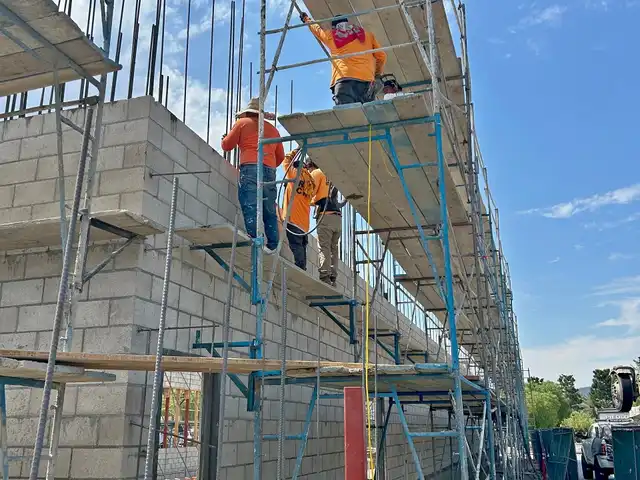

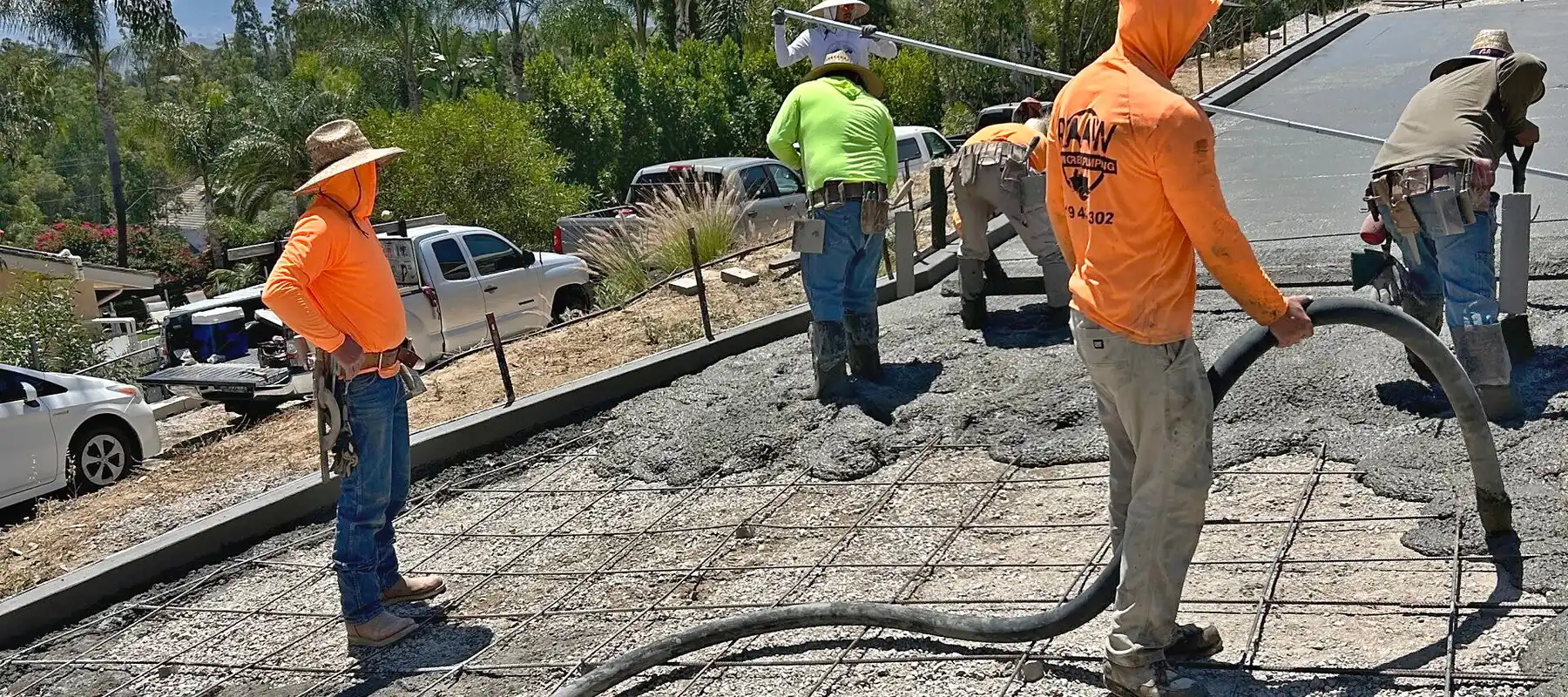
What do San Diego County's climate and soils mean for your concrete?
San Diego County has a coastal Mediterranean climate, so we place concrete year-round with essentially no freeze-thaw exposure. The real challenges are inland summer heat, moisture swings in clay soils, and seismic code requirements for footings and slabs.
Coastal Air Versus Inland Heat
The coastal marine layer keeps temperatures mild and humidity higher, which slows evaporation. Inland, in Escondido, Poway, Santee and El Cajon, summer highs push placement into hot-weather territory: high air temperature, low humidity, wind and sun pulling moisture out of the slab.
On those days we start early, dampen the subgrade, forms and rebar before the pour, and use fog misting or evaporation retarders when wind and low humidity are forecast.
Then we keep the slab moist for 3 to 7 days, because concrete cured hot and dry ends up weaker at 28 days than the same mix cured near 70°F.
Expansive Clay Under Older Tracts
Much of the county's housing went up in the 1970s and 80s building boom, on cut-and-fill lots over expansive clay that swells when wet and shrinks when dry. That is why so many slabs from that era show differential settlement and cracking.
- Median Year Built, County-Wide
- 1981
- Homes Built Before 1980
- About 48%
The California Building Code calls soil expansive when its expansion index exceeds 20, alongside plasticity and grain-size tests. On moderately expansive single-story sites we follow the prescriptive design in County of San Diego PDS 065.
- Footings Below Grade
- At least 24 in
- Footing Steel
- Four continuous #4 bars
- Slab And Footing
- Poured monolithic
- Slab
- 4 in, #4 bars at 18 in each way
- Moisture Barrier
- 10 mil
- Subgrade
- Presaturated
- Control Joints, 4 in Slab
- 24–36 × thickness, about 10 ft
For flatwork that means a compacted base, real reinforcement and joints cut on that spacing, so the slab cracks where we put the line rather than where the clay decides.
Seismic Reinforcement
The Rose Canyon, Elsinore and San Jacinto faults put Alquist-Priolo zones across the county. Footings and stem walls here are reinforced to the California Residential Code for Seismic Design Categories D0 through D2.
- Footing And Stem Wall Steel
- No. 4 bars
- Cover Where Cast Against Earth
- 3 in
- Code Minimum, Negligible-Weathering Coast
- 2,500 psi
- Typical Driveway And Garage Slab
- 3,000–4,000 psi
We match the mix to how the slab will actually be used, not to the code floor.
What concrete projects do we do most in San Diego County?
Raaw Concrete Inc. is a family-owned concrete contractor headquartered in Oceanside, California. Our most common San Diego County jobs:
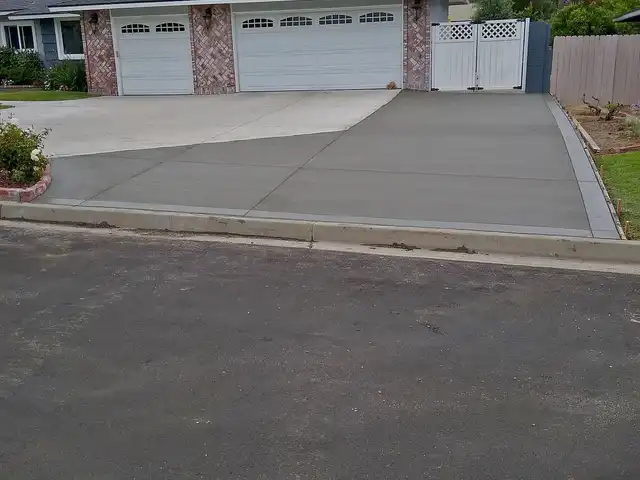
- Driveway and Walkway Replacement in older tracts where the original slab has settled or spalled. See concrete driveways and walkways.
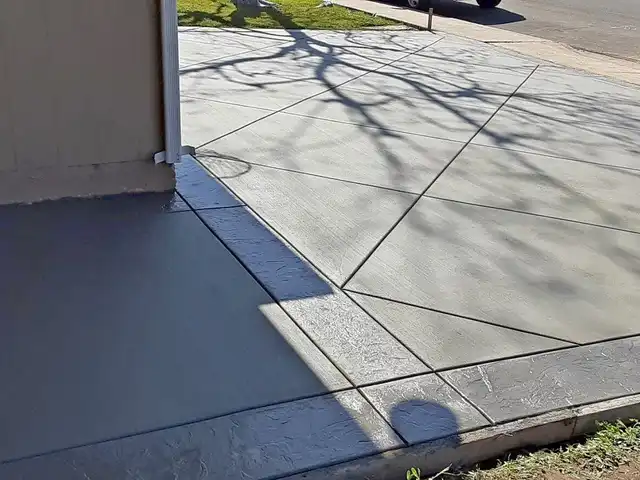
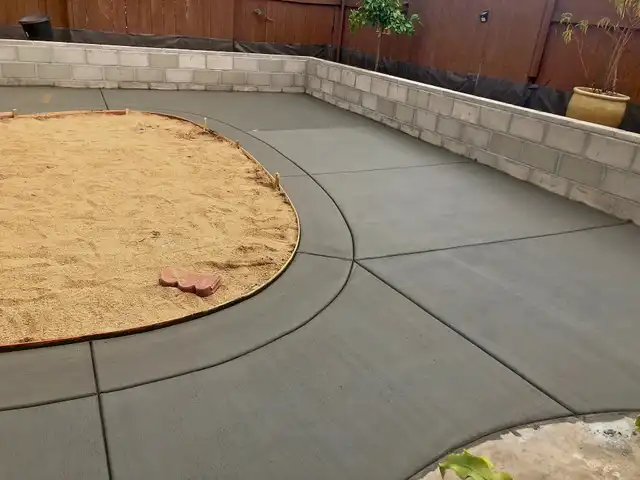
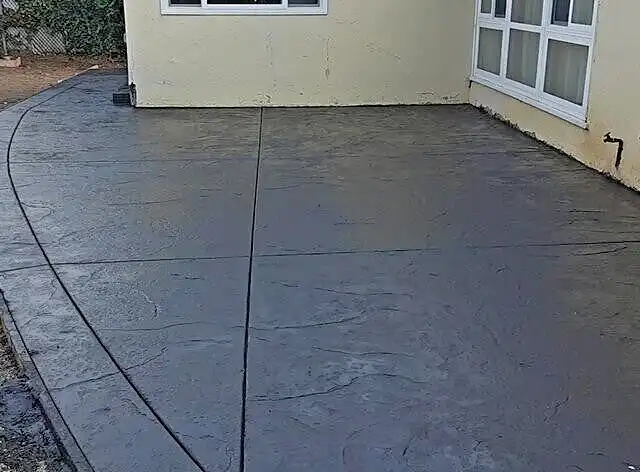
- Patios, Sidewalks, Curbs and Approaches, broom-finished or with a stamped border. See patios, sidewalks and flatwork.
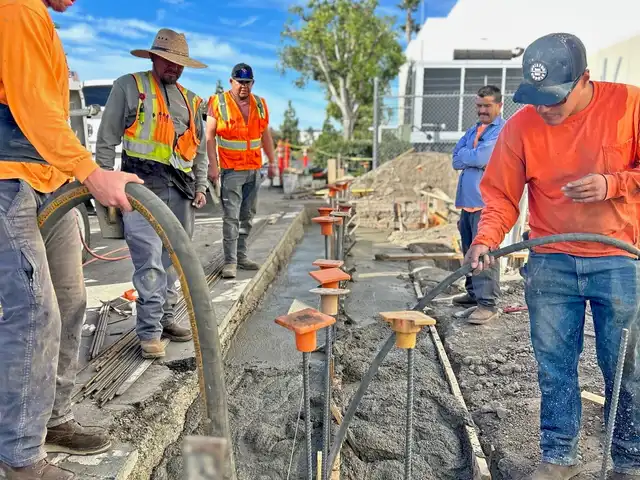
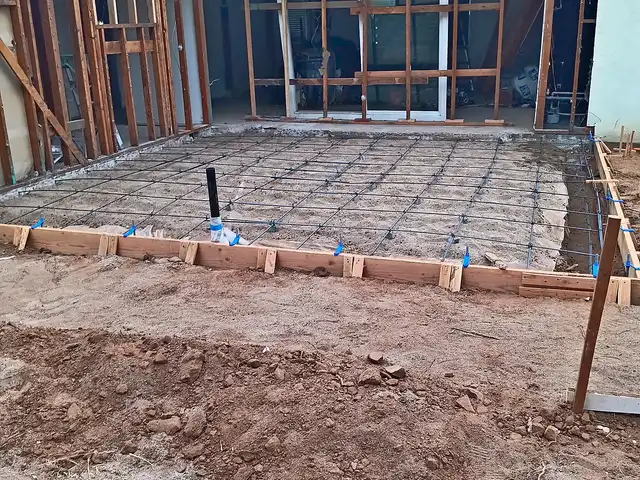
- ADU, Garage and Addition Foundations poured to the engineer's plan and ready for inspection. See concrete foundations and slabs.
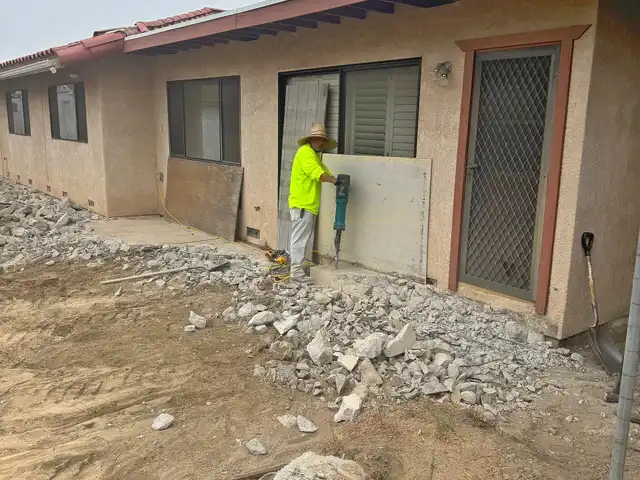
- Demolition and Haul-Away of cracked slabs before new work goes in. See concrete demolition and removal.
- Repair-or-Replace Assessments for settled, heaved or crumbling concrete. See concrete repair and replacement.
Do you need a permit for concrete work in San Diego County?
Usually not for flatwork on your own property, and almost always for anything in the street. The California Residential Code exempts sidewalks and driveways from a building permit, though cities can amend that list.
Foundations, ADU slabs and other structural concrete are not exempt and go through plan check.
Work in the public right-of-way, meaning a driveway approach, curb cut, gutter or public sidewalk, needs a permit from the local agency:
- Unincorporated Areas such as Fallbrook, Bonsall, Ramona, Lakeside and Spring Valley: County of San Diego Planning & Development Services, Building Division (opens in a new tab).
- City of San Diego: Right-of-Way Permit; under Information Bulletin 165, a residential driveway remove-and-replace and up to 150 linear feet of curb, gutter and sidewalk qualify for over-the-counter Rapid Review.
- City of Oceanside: the Transportation Engineering Section requires a permit for driveway improvements in the right-of-way and for driveway relocations.
- The Other 16 Cities each run their own building and engineering counters.
Stormwater rules under the County's BMP Design Manual apply above set thresholds. Typical residential driveways and patios fall well under them.
- Replaced Impervious Surface, On Sites Already At 10,000 sq ft Or More
- 5,000 sq ft
- Draining Directly To An Environmentally Sensitive Area
- 2,500 sq ft
We identify which rules apply during the estimate.
What does concrete cost in San Diego County?
Published San Diego-area ranges for 2025 and 2026 give a starting point. Every project is priced after a site visit, because access, demolition, base depth and finish drive the number.
| Project (San Diego Area, 2025–2026) | Published Range | Source |
|---|---|---|
| Standard Driveway | $10–$18 per sq ft | Sal & Bros, Oct 2025 |
| Stamped Driveway | $15–$28 per sq ft | Sal & Bros, Oct 2025 |
| Patio, Broom Finish | $12–$16 per sq ft | Sal & Bros, Oct 2025 |
| Concrete removal (most residential jobs $3–$5) | $2–$6 per sq ft | Demo Diego, 2026 |
How far do we travel, and how do we schedule from Oceanside?
Our yard is at 2033 S Freeman St in South Oceanside, at the top of the county.
- Down I-5. Carlsbad, Encinitas, Solana Beach and Del Mar, a short run.
- Along SR-78. Vista, San Marcos and Escondido.
- Via I-15. Poway, San Diego and the South Bay.
- Via I-5 and I-805. Chula Vista, National City, Lemon Grove, Imperial Beach and Coronado.
Crews are out from 5 a.m. Monday through Saturday, so the pump truck and ready-mix reach inland sites before the heat and the slab is curing before the afternoon wind.
Most residential projects take about three working days from demolition to finished pour, depending on the job. You get a written schedule before we start.
Curing follows the standard schedule:
- Walk On It
- 24–48 hours
- Park A Car On It
- 14 days
- Full Cure
- 28 days
We also serve Orange County and Riverside County from the same Oceanside yard. Call (714) 321-0105 or request an estimate and we will walk your site.