
What decorative concrete finishes do we offer?
Raaw Concrete Inc. is a family-owned, licensed, bonded and insured concrete contractor in Oceanside, California. We pour decorative and specialty finishes for homeowners, builders and property managers across San Diego, Orange, Riverside and Los Angeles counties.
Every finish here starts with the same base prep, reinforcement and joint layout we use on our driveways and walkways and on patios and flatwork.
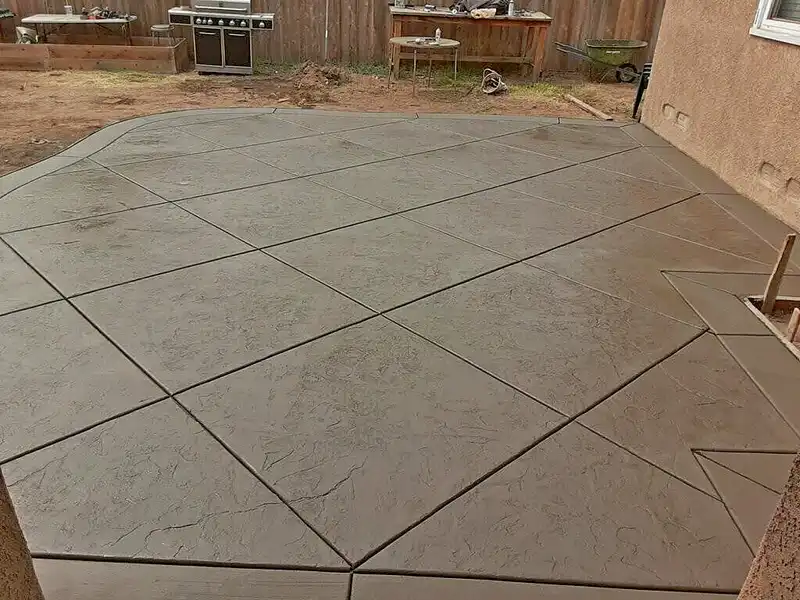
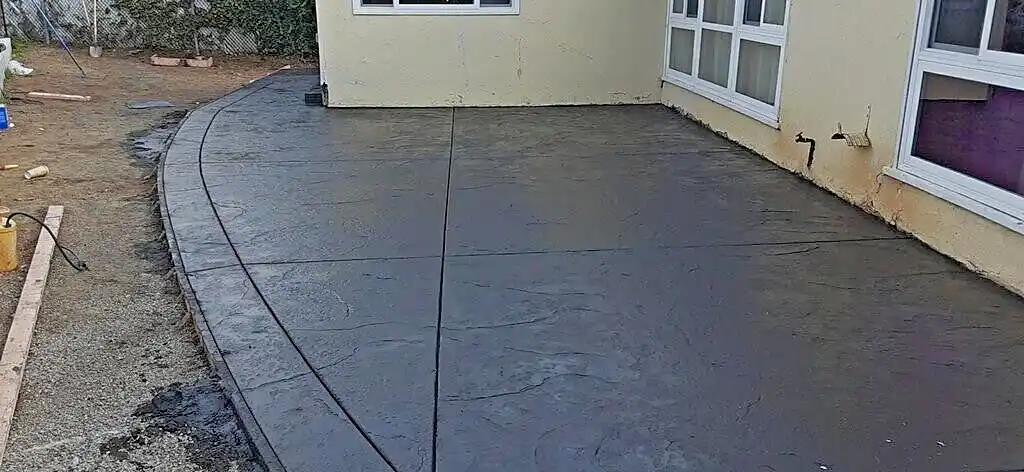
- Stamped concrete. Texture mats press a stone, slate, tile or wood-plank pattern into the fresh surface. Color comes from integral pigment, a dry-shake hardener or both, and a release agent leaves a darker accent in the low spots.
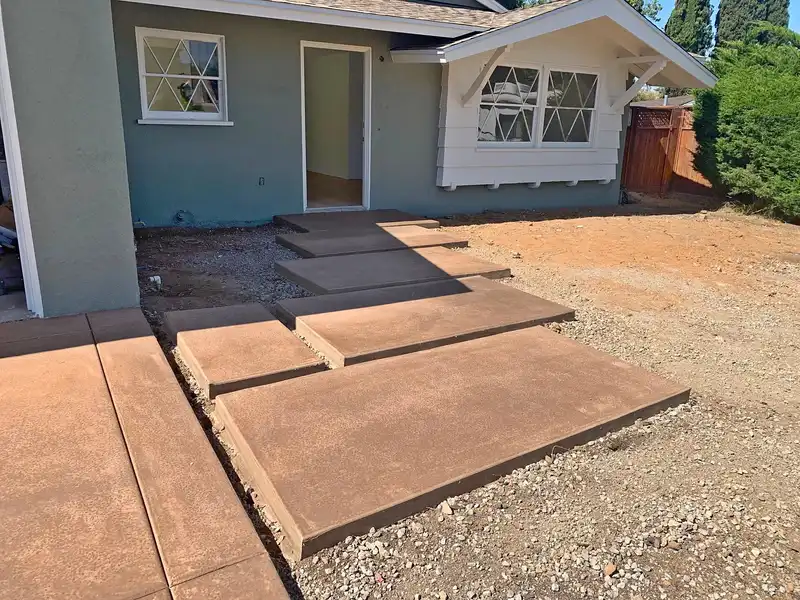
- Integrally colored concrete. Pigment is batched into the truck, so the color runs the full depth of the slab. A terracotta broom-finished driveway is the classic Southern California example.
- Exposed aggregate. The top layer of cement paste is washed away to reveal the stones in the mix, leaving a natural, slip-resistant surface.
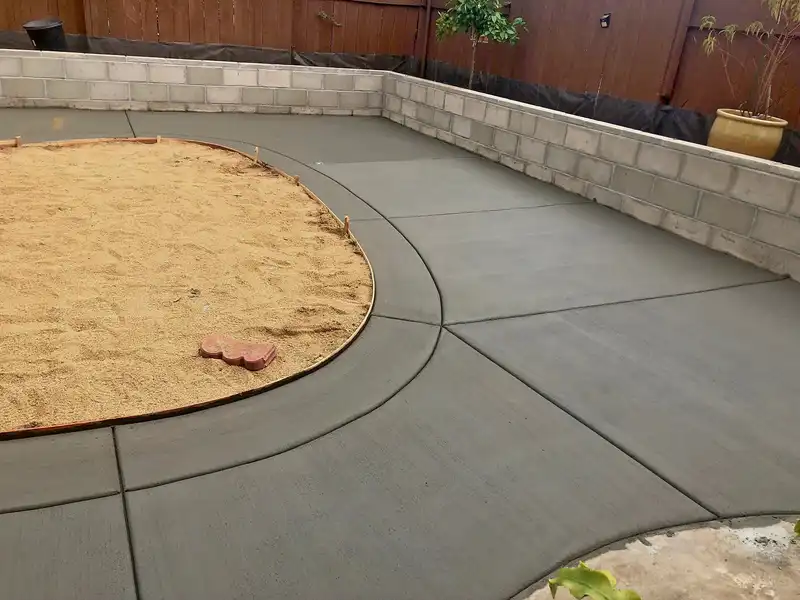
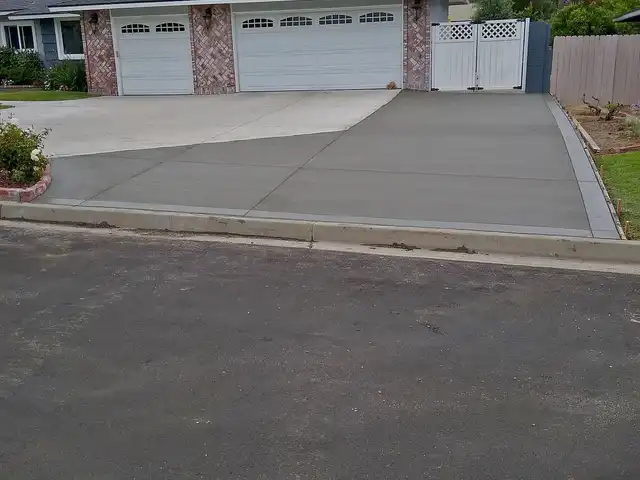
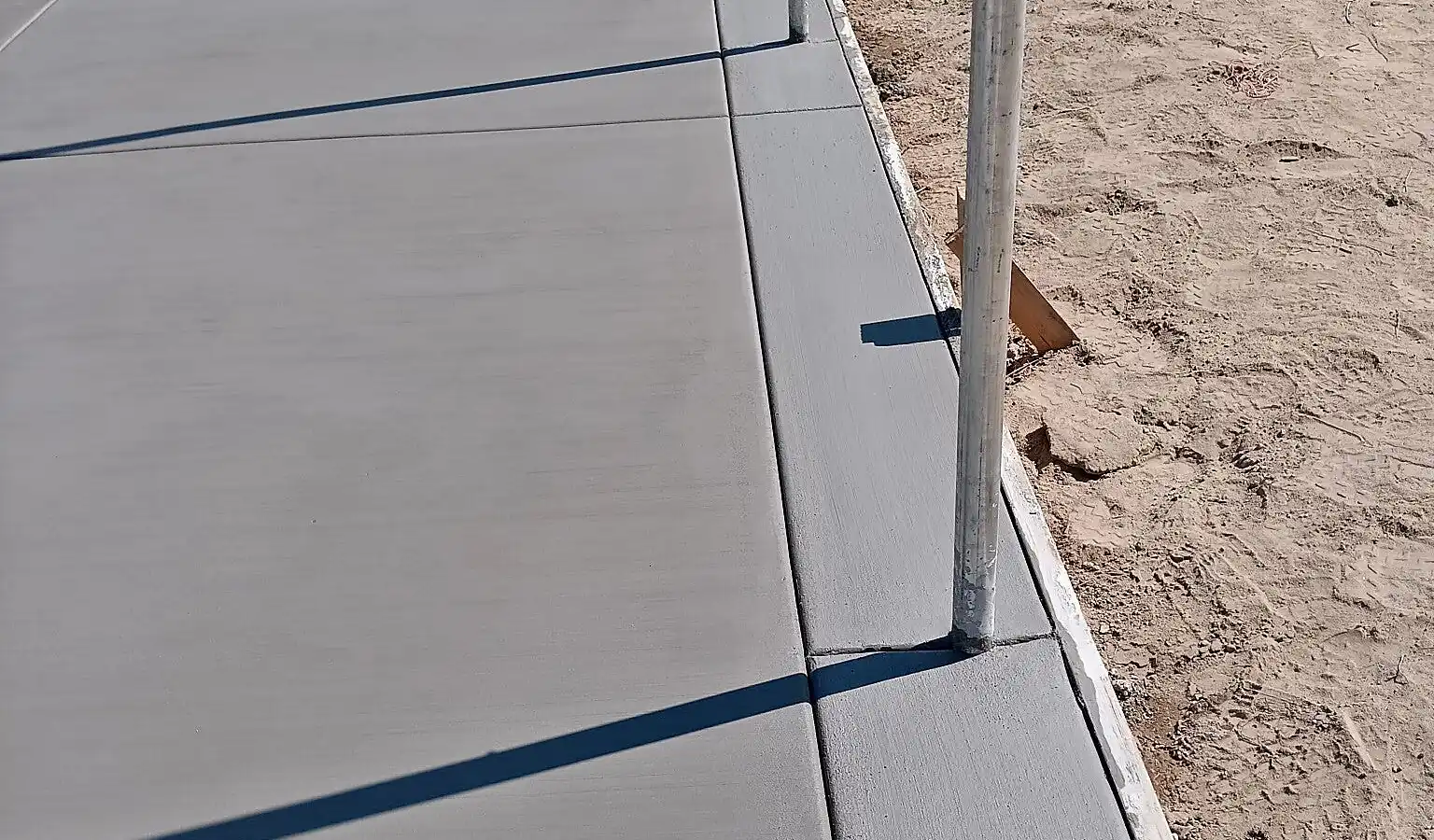
- Broom finish with borders. A broom-textured field framed by a smooth-troweled or stamped band. It is the most affordable way to add definition.
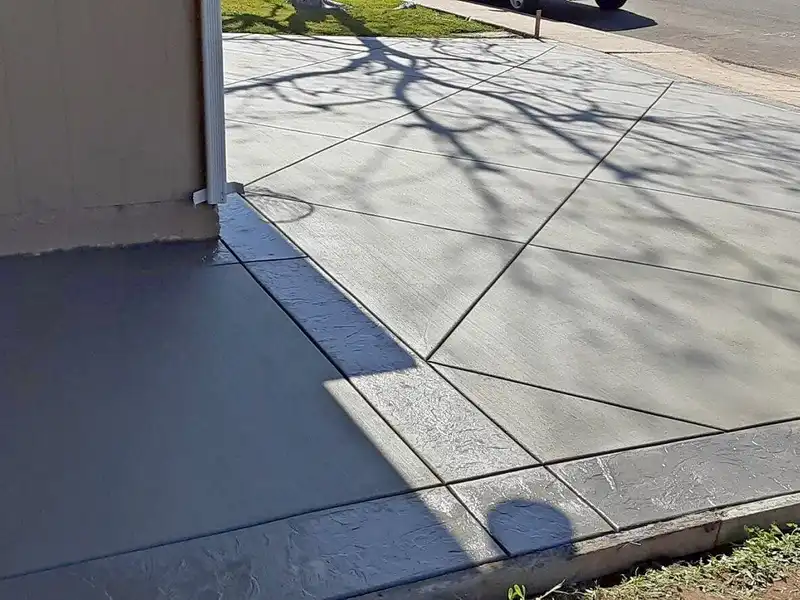
- Saw-cut patterns. Diagonal, diamond or grid lines cut after the pour. Spaced like control joints, the cuts do both jobs.
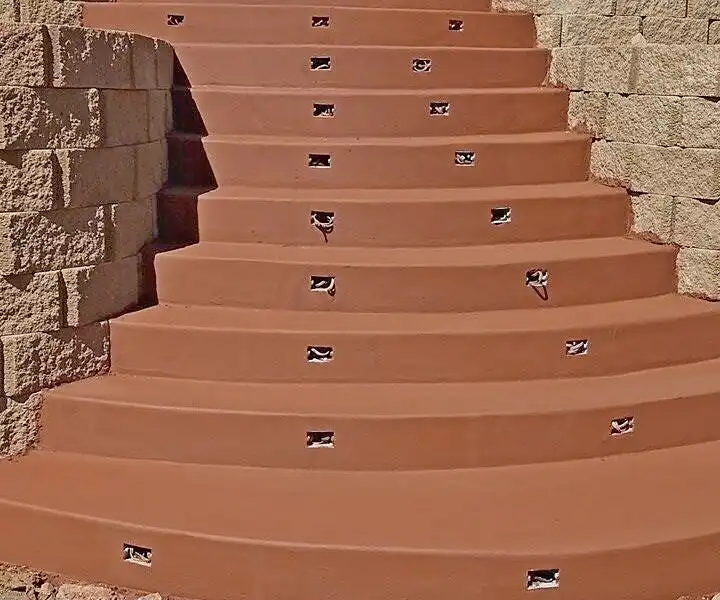
- Colored steps and landings. Poured steps in the same integral color as the patio or driveway they connect to, including curved runs between retaining walls.
- Custom borders and bands. Contrasting color or texture at the edges, around planters or along a driveway apron.
How is stamped and colored concrete actually installed?
Decorative work follows the same steps as any slab; timing decides the result.
- Base and forms. We excavate, compact the base and set forms sloped at least 1/4 inch per foot away from the house. That is the 2 percent the California Residential Code requires within 10 feet of a foundation.
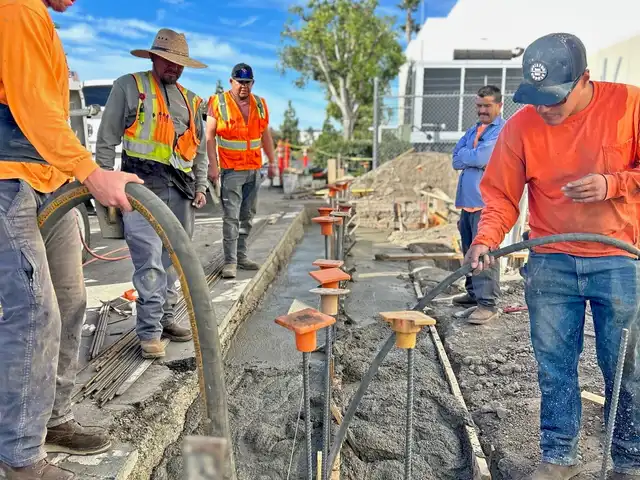
- Reinforcement. Rebar at 18 inches on center each way, not wire mesh. It sits on chairs, not on the dirt.
- Color. Integral pigment goes in at the batch plant. For stamped work we can also float a dry-shake color hardener into the surface for a denser top and a richer tone.
- Place, screed and float. On hot, dry or windy days we dampen the subgrade and forms and use evaporation retardants or windbreaks.
- Stamp. Once the surface holds a thumbprint without sticking, we apply release agent and press the mats in sequence. The window is short, so crew size is matched to the pour.
- Cut joints. Early-entry saws run 1 to 4 hours after finishing, conventional saws 4 to 12 hours. Depth is at least one-quarter the slab thickness and never less than 1 inch.
- Cure. Curing continues for 3 to 7 days. Foot traffic is fine at 24 to 48 hours and vehicles at 14 days.
- Wash and seal. After curing we wash off the release residue, let the slab dry and apply sealer, with slip-resistant grit on steps and pool surrounds.
For exposed aggregate, a surface retarder goes on the fresh concrete and the top paste is washed off the next day to reveal the stone.
How do you seal and maintain decorative concrete?
Sealer protects the color and texture from UV, tire marks and stains. Stamped and exposed aggregate surfaces typically need resealing every two to three years in Southern California sun; a plain broom field can go longer.
Driveways and pool surrounds in full sun need it sooner than shaded patios. Coastal salt air in Oceanside and other beach cities shortens sealer life.
- Sweep and rinse regularly. Spot-clean oil or rust before it sets in.
- Keep sprinklers off the slab. Constant wetting shortens sealer life and leaves mineral deposits.
- Reseal when water stops beading or the color looks dull, using the same sealer family we note at the final walkthrough.
- If a section cracks or settles, call before it spreads. Our concrete repair and replacement crew can often match an integrally colored section.
Which finish is right for your patio or driveway?
Each option trades cost, upkeep and traction differently. The table lists San Diego contractor figures from late 2025.
| Finish | Typical Installed Cost, San Diego (2025) | Pros | Cons |
|---|---|---|---|
| Broom Finish With Border | $12 to $16 per sq ft (patio) | Lowest cost; best traction; border gives a finished edge | Plain gray field unless colored |
| Integrally Colored Broom | Broom range plus pigment | Color goes full depth; chips do not show gray; little upkeep | Earth-tone palette; slight batch-to-batch variation |
| Saw-Cut Pattern | Broom range plus sawing labor | Clean geometric look; cuts double as control joints | Cuts must be timed and cut to depth; not a stone look |
| Exposed Aggregate | $14 to $22 (patio); $15 to $22 (driveway) | Natural stone look; excellent slip resistance; hides wear | Rough on bare feet; needs sealer to lock the stones |
| Stamped | $18 to $25 (patio); $18 to $28 (driveway) | Stone, slate, tile or wood looks; widest color range | Highest cost; resealing needed; cracks show more; can be slick when wet |
San Diego figures published by Sal & Bros.
Nationally, stamped work is listed wider:
- Stamped, National Typical
- $12–$18 / sq ft
- Stamped, Full National Range
- $8–$26 / sq ft
National ranges published by HomeAdvisor and HomeGuide, 2026.
How do you design decorative concrete for a Southern California home?
- Mind the heat. Dark charcoal looks sharp against light stucco, but dark surfaces absorb more sun. For pool surrounds and barefoot patios we lean toward tans, sands and lighter grays.
- Match the house. Pull color from roof tile, stucco or stone veneer. Terracotta suits Spanish and ranch homes; slate gray and charcoal suit modern builds.
- Use borders to organize space. A contrasting band around a broom or stamped field frames the patio and hides the transition to existing concrete.
- Plan drainage first. Slope away from the house toward landscape or drains. In the City of San Diego, replacing 5,000 sq ft or more of impervious surface on a site that has 10,000 sq ft or more triggers Priority Development Project stormwater rules (Form DS-560).
- Respect the soil. Parts of Orange County, the San Fernando Valley and inland Los Angeles County sit on expansive clay. There we presaturate the subgrade before the pour, as San Diego County's PDS 065 prescribes for slabs on moderately expansive soil. Our rebar at 18 inches on center each way holds any cracks tight.
- Pair with drought-tolerant planting. Decorative concrete replaces irrigated lawn, and a colored border makes gravel and succulent beds look intentional.
Our crews in San Diego County and Orange County start at 5 a.m., and that matters for decorative pours. Hot-weather concreting starts at 80°F, so an early start puts the stamping window ahead of the afternoon heat.
Stamped concrete or pavers: which holds up longer?
Both are durable on a properly compacted base. Pavers are individual units set in sand: they can shift, settle and grow weeds in the joints, but one paver can be lifted and reset.
Stamped concrete is one continuous slab with no sand joints. It relies on reinforcement and control joints to manage cracking, and it needs resealing on a schedule.
Concrete makes sense for a seamless, integrally colored surface. Pavers make sense when you expect to reopen the ground for utilities.
What does decorative concrete cost in Southern California?
All figures here are installed cost per square foot.
- San Diego driveways, December 2025: basic $12 to $18; exposed aggregate $15 to $22; stamped $18 to $28.
- San Diego patios, October 2025: broom $12 to $16; exposed aggregate $14 to $22; stamped or stained $18 to $25.
- Orange County patios, April 2022, dated: reinforced $7 to $13; stamped $10 to $18.
- National, June 2026: plain $6 to $8; broom $8 to $12; stamped $12 to $18.
Sources, in order: Sal & Bros, HomeBlue, HomeAdvisor.
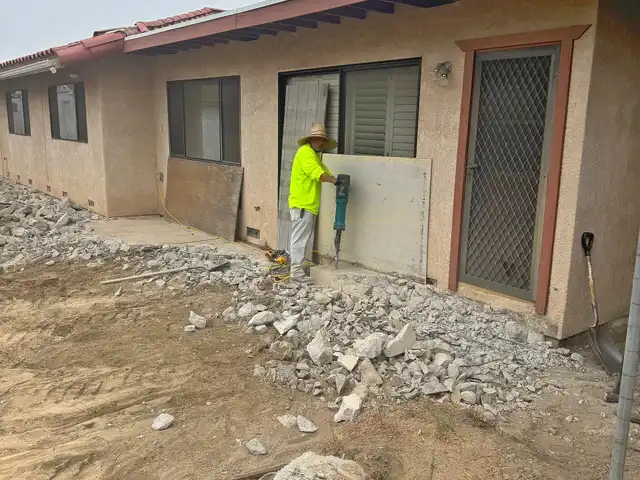
Taking out an old slab adds to the number:
- Slab Removal, Southern California
- About $2–$6 / sq ft
- Slab Removal, San Diego
- $3–$6 / sq ft
Removal ranges published by CNS Demo, 2026, and Sal & Bros.
See concrete demolition and removal for that work. Pattern complexity, colors, borders, curves and site access move a quote within these ranges, and our estimate itemizes each one.
Why choose Raaw Concrete Inc. for decorative work?
Co-founders Willie and Ryan Dupleich are both on site on every job, and Ryan is the qualifying individual on CSLB License #1125756 (C-8 Concrete). We are licensed, bonded and insured, family-owned and referral-driven, so a stamped patio has to look right up close.
Most residential projects finish in about three working days, depending on the job. Browse our recent decorative projects, then request a free, itemized estimate or call (714) 321-0105.